Guide
Song structure for beginners: forms, bars, and tags
Song structure is the plan for when each musical idea arrives, repeats, changes, and ends. If you know the bar count, BPM, and job of each section, you can write faster, arrange cleaner in a DAW, and give an AI generator better section instructions.
By SoundUser teamUpdated 10 min read

Quick answer
A safe beginner song structure is Intro 4 bars, Verse 16, Pre-Chorus 8, Chorus 16, Verse 16, Pre-Chorus 8, Chorus 16, Bridge 8, Chorus 16, Outro 8. That is a 116-bar pop layout. In 4/4, one bar in seconds = 240 / BPM, so at 124 BPM, 16 bars is about 31 seconds and the full form is about 3:44. If the draft runs long, cut verse 2 to 8 bars before you shrink every section.
Try it while you read
The verse chorus bridge map tells the listener where they are
Song structure works when each section has a job the listener can feel. A verse tells the story, usually with lower energy, new details, and 8 or 16 bars. The pre-chorus tilts upward for 4 or 8 bars. Push the melody higher, tighten the rhythm, and lean on a tension chord such as V or iv. The chorus states the main claim. Put the title phrase there. Repeat it. Make the hook obvious.
A bridge changes the angle for 4 or 8 bars. Start it on a different chord, thin the drums, or swap the lead sound. The outro lands the song with 4 or 8 bars, often by repeating the title or stripping down. If your words stall, build the lyric section by section with lyrics written for each song section.
| Section | Emotional job | Usual bars | Musical move | Lyric move |
|---|---|---|---|---|
| Verse | Tell | 8 or 16 | Am - F - C - G | New scene or detail |
| Pre-Chorus | Tilt | 4 or 8 | Dm - F - G - G | Pressure rises |
| Chorus | State | 8 or 16 | F - C - G - Am | Title and main claim |
| Bridge | Reframe | 4 or 8 | Dm - Am - F - G | Different angle |
| Outro | Land | 4 or 8 | Hold tonic or loop chorus | Repeat or fade idea |
Bar counts plus BPM turn a song form into real minutes
You can time any song structure by multiplying its bar count by 240 divided by the BPM. The formula works in 4/4 because a bar has 4 beats, and each beat lasts 60 / BPM seconds. So one bar is 4 x 60 / BPM, which becomes 240 / BPM.
At 104 BPM, one bar is 2.31 seconds. That makes 8 bars 18.46 seconds and 16 bars 36.92 seconds. At 124 BPM, one bar is 1.94 seconds, so 16 bars is 30.97 seconds. At 92 BPM, one bar is 2.61 seconds, and a 16-bar rap verse is about 41.74 seconds. Same bars. Different weight.
Drop DAW markers on every section, then check the ruler before you write more lyrics. A slow ballad can feel huge with the same bar count that feels tight in a fast pop track. For grid work, markers, and arranging blocks, keep DAW arrangement tips open while you sketch.
| BPM | Seconds per bar | 4 bars | 8 bars | 16 bars |
|---|---|---|---|---|
| 76 | 3.16 | 12.63 | 25.26 | 50.53 |
| 92 | 2.61 | 10.43 | 20.87 | 41.74 |
| 104 | 2.31 | 9.23 | 18.46 | 36.92 |
| 120 | 2.00 | 8.00 | 16.00 | 32.00 |
| 124 | 1.94 | 7.74 | 15.48 | 30.97 |
Common song forms by genre, with bars and seconds
Pick the form by deciding which section carries the hook: chorus, hook, drop, solo, refrain, or loop. Pop usually wants the chorus to do the heavy lifting. Hip hop can put the hook before verse 1. EDM often treats the drop as the main payoff, so the vocal can be shorter than a pop vocal.
Do not copy a table like it is a law. Use it as a starting arrangement. If your title line is strong, give the chorus 16 bars. If the beat is the point, keep vocal sections lean and let the drop, hook, or loop speak.
| Form | Section order with bar counts | BPM used | Total bars | Approx duration | Best use |
|---|---|---|---|---|---|
| Pop | Intro 4, Verse 16, Pre 8, Chorus 16, Verse 16, Pre 8, Chorus 16, Bridge 8, Chorus 16, Outro 8 | 124 | 116 | 3:44 | Big chorus songs |
| Pop slower | Same 116-bar form | 104 | 116 | 4:28 | When lyrics need room |
| Ballad | Intro 4, Verse 16, Chorus 8, Verse 16, Chorus 8, Bridge 8, Chorus 12, Outro 4 | 76 | 76 | 4:00 | Emotional vocal focus |
| EDM | Intro 8, Verse 16, Build 8, Drop 16, Verse 8, Build 8, Drop 16, Breakdown 8, Drop 16, Outro 8 | 124 | 112 | 3:37 | Build and drop tracks |
| Hip hop | Intro 4, Hook 8, Verse 16, Hook 8, Verse 16, Hook 8, Bridge 8, Hook 8, Outro 4 | 92 | 80 | 3:29 | Hook plus 16-bar verses |
| Rock | Intro 4, Verse 16, Chorus 8, Verse 16, Chorus 8, Guitar Solo 8, Bridge 8, Chorus 16, Outro 4 | 120 | 88 | 2:56 | Riff, solo, final chorus |
| Folk | Intro 4, Verse 12, Verse 12, Chorus 8, Verse 12, Chorus 8, Bridge 8, Chorus 8, Outro 4 | 88 | 76 | 3:27 | Story verses and refrain feel |
| Lo-fi loop | Intro 4, Verse 8, Hook 8, Verse 8, Hook 8, Interlude 8, Hook 8, Outro 4 | 80 | 56 | 2:48 | Repeating mood and short hook |
| AABA | A8, A8, B8, A8 core, then repeat with 4-bar intro and 4-bar outro | 112 | 72 | 2:34 | Compact melodic writing |
An energy map stops the second chorus from feeling copied
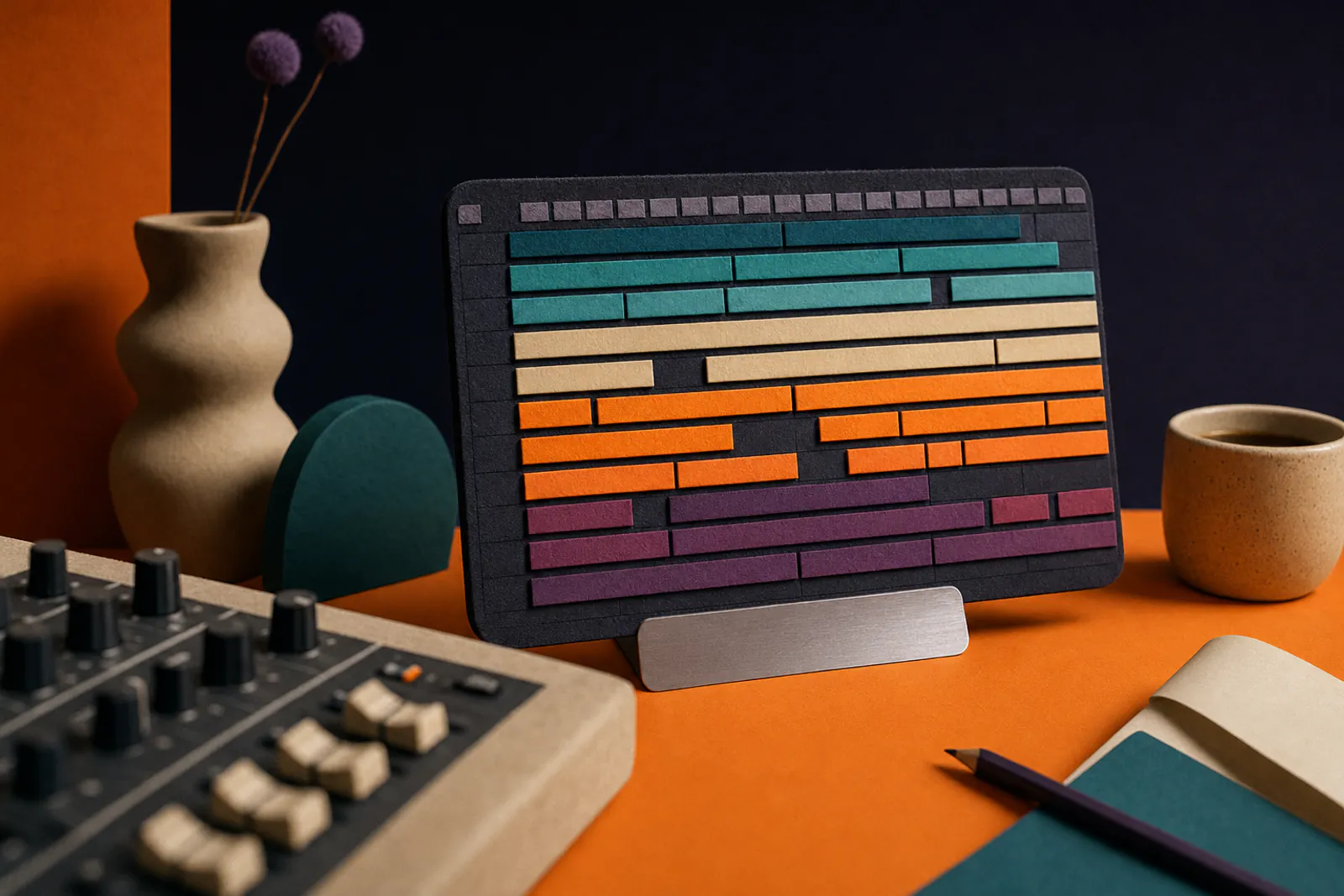
An energy map marks the quietest and loudest bars before you lock the arrangement. Rate each section from 1 to 5, where 1 is a sparse vocal or loop, and 5 is the biggest drum, bass, harmony, and lead stack. A clean pop map might be Intro 2, Verse 1 at 2, Pre-Chorus 3, Chorus 4, Verse 2 at 3, second chorus 4, Bridge 2, final chorus 5, Outro 2.
Put the quietest bars in verse 1 or the bridge. Do not drain energy before every chorus or the track starts apologizing for itself. Put the loudest bars in final chorus bars 1-8 or drop bars 1-16. One small fix can save a flat repeat: kill the kick in pre-chorus bar 8, then slam it back on the chorus downbeat. For better fills and lift, use drum programming tips.
Does the song earn its second chorus?
- Verse 2 adds new information, not the same complaint again.
- The drum pattern changes before chorus 2.
- The bass moves to a new octave or rhythm.
- The final chorus has one new sound or harmony.
- A fill points into the chorus downbeat.
- The ending has a clear stop, tag, or stripped repeat.
A worked 3:08 pop structure at 104 BPM
A 3:08 pop song at 104 BPM can work if you use shorter early sections and save the longest chorus for the end. At 104 BPM, one bar is 2.3077 seconds. This example uses 81.5 bars, so 81.5 x 2.3077 = 188.08 seconds, which is about 3:08.
Input prompt you could copy: 104 BPM, C major/A minor, tight pop structure, short first chorus, bigger final chorus, verse Am-F-C-G, chorus F-C-G-Am.
Expected result: the first payoff arrives fast, verse 2 does not drag, and the final chorus feels earned because it is twice as long as the first one. If it misses and the first chorus arrives too late, change only Verse 1 12 bars to Verse 1 8 bars. Do not also cut the pre-chorus, or you may lose the lift.
| Section | Bars | Start | End | Chords | Arrangement note |
|---|---|---|---|---|---|
| Intro | 4 | 0:00 | 0:09 | Am | Hook sound preview |
| Verse 1 | 12 | 0:09 | 0:37 | Am - F - C - G | Lean drums |
| Pre-Chorus | 4 | 0:37 | 0:46 | Dm - F - G - G | Lift hats, hold bass |
| Chorus | 8 | 0:46 | 1:05 | F - C - G - Am | Title line |
| Post-Chorus | 2 | 1:05 | 1:09 | F - G | Short chant |
| Verse 2 | 8 | 1:09 | 1:28 | Am - F - C - G | Add counter melody |
| Pre-Chorus | 4 | 1:28 | 1:37 | Dm - F - G - G | Snare fill |
| Chorus | 8 | 1:37 | 1:55 | F - C - G - Am | Wider vocal |
| Bridge | 8 | 1:55 | 2:14 | Dm - Am - F - G | Strip drums |
| Break | 0.5 | 2:14 | 2:15 | G | Silence hit |
| Final Chorus | 16 | 2:15 | 2:52 | F - C - G - Am | Full stack |
| Outro | 7 | 2:52 | 3:08 | Am | Land on hook sound |
Cut a 4:00 draft to 3:00 by removing repeat time
The cleanest way to shorten a song is to cut repeated setup, not the hook people came for. A 116-bar pop structure at 104 BPM is about 4:28. An 80-bar version at the same tempo is about 3:05, and it often feels stronger because the song stops explaining itself.
At 104 BPM, an 8-bar cut saves 18.46 seconds. Three 8-bar cuts save about 55.38 seconds. Good targets: halve verse 2, trim the intro, remove the post-chorus after chorus 1, or make the bridge 4 bars. Bad targets: chopping every chorus to 4 bars, deleting all contrast before the final chorus, or fading before the title lands.
If editing terms still feel fuzzy, review basic production terms and arrangement moves before you start dragging blocks around.
| Edit | Bars removed | Seconds saved at 104 BPM | When to use it |
|---|---|---|---|
| Remove an 8-bar intro | 8 | 18.46 | Vocal should enter sooner |
| Cut verse 2 from 16 to 8 | 8 | 18.46 | Story already moved forward |
| Remove an 8-bar bridge | 8 | 18.46 | Bridge repeats the pre-chorus mood |
| Shorten outro from 16 to 4 | 12 | 27.69 | Ending hangs too long |
| Cut 4 bars from final chorus | 4 | 9.23 | Final hook repeats without gain |
Instrumental songs still need sections
A song with no vocals still needs structure because the hook moves from lyric to melody, rhythm, sound design, or chord color. Replace the verse with an A theme, the chorus with the main hook, and the bridge with a breakdown or new chord area. If you want a purely instrumental result, an instrumental music generator prompt should still name the sections.
Try this 96 BPM form: Intro 4, A Theme 8, B Theme 8, Hook 8, A Theme 8, Breakdown 8, Hook 16, Outro 4. At 96 BPM, one bar is 2.5 seconds, so this 64-bar form is 2:40. Chord map in D minor: A theme Dm - Bb - F - C, B theme Gm - Bb - C - C, hook Bb - F - C - Dm.
Prompt: instrumental, 96 BPM, D minor, A theme 8 bars, hook 8 bars, breakdown 8 bars, final hook 16 bars, no vocals.
If it feels like a loop, change only the breakdown chord start to Gm and mute the drums for 4 bars.
| Vocal section name | Instrumental replacement | What changes | Tag to use |
|---|---|---|---|
| Verse | A Theme | Melody register | [Instrumental] |
| Pre-Chorus | B Theme | Chord tension | [Interlude] |
| Chorus | Hook | Main melody and bass | [Instrumental] |
| Bridge | Breakdown | Drums and chord start | [Breakdown] |
| Outro | Landing | Texture thins | [Outro] |
Frequently asked questions
How long should a song be in 2026?
Aim for the length the structure earns. For many vocal songs, 2:40 to 3:30 is practical because the hook arrives fast and repeats enough to stick. A slow ballad can pass 4:00 if the vocal performance keeps changing shape. A loop-based track may work closer to 2:00 if the core idea is the whole point.
What is the most common song structure?
The most common beginner-friendly form is verse, pre-chorus, chorus, verse, pre-chorus, chorus, bridge, chorus, outro, often with a short intro. In bars, a full pop version might be 4, 16, 8, 16, 16, 8, 16, 8, 16, 8. At 124 BPM, that 116-bar layout is about 3:44.
How many bars should a verse be?
A verse is usually 8 or 16 bars. Use 8 bars when the chorus needs to arrive fast or the lyrics are simple. Use 16 bars when the story needs more setup, which is common in hip hop, ballads, and narrative folk writing. At 104 BPM, 16 bars lasts about 36.92 seconds.
Do I need a bridge in every song?
No. Add a bridge when the song needs a new angle before the final chorus. Skip it if verse 2 already changes the story, the drop is the main payoff, or the track gets weaker when you leave the hook. A 4-bar bridge can be enough: new chord start, thinner drums, one direct lyric.
What is the difference between a pre-chorus and a bridge?
A pre-chorus happens before a chorus and builds tension into it. It often uses 2 to 4 lyric lines and 4 or 8 bars. A bridge usually appears after the second chorus and changes perspective, chords, or texture. Think of the pre-chorus as a ramp, and the bridge as a turn.
How do I structure a song with no vocals?
Give the instrumental sections jobs. Intro sets the sound, A theme introduces the main idea, B theme adds contrast, hook carries the strongest melody, breakdown resets energy, and outro lands. At 96 BPM, a 64-bar instrumental form lasts 2:40, which is enough for two hook passes and one reset.
How do I tell an AI generator which structure I want?
Put section tags on their own lines in the lyrics field, then place the lyric lines under each tag. Use tags like [Intro], [Verse 1], [Pre-Chorus], [Chorus], [Bridge], [Outro], and [End]. Keep verses under about 12 lines. Put BPM, key, genre, and arrangement notes in the style prompt.
Keep exploring
 Learn music production with AI, from beats to promptsLearn AI music production through beginner guides on computers, drum programming, sequencers, arrangement, and prompt writing for finished tracks.
 Sequencer tips for turning loops into full songsSequencer tips for turning loops into songs with 8-bar blocks, bar maps, quantize strength, piano roll fixes, automation, MIDI CC, and AI sketches.
 Suno meta tags for cleaner lyric blocksUse Suno meta tags in lyrics with verse, chorus, build, drop, delivery cues, placement rules, copy-ready skeletons, and sung-tag fixes for cleaner song forms.
 How to write song lyrics that sing cleanlyLearn how to write song lyrics with chorus-first steps, syllable counts, rhyme schemes, concrete verse images, and AI-ready tags that sing cleanly.
 Music Production for Beginners: Make a First SongLearn music production for beginners with a 7-day first-song plan: BPM, key, 8-bar loop, AI sketches, arrangement, and rough-mix numbers you can use.
 Drum programming tips for DAW grids and AI drumsDrum programming tips with 16-step grids, BPM ranges, swing, velocity, humanize timing, hi-hat rolls, fills, layering, and AI prompts to copy.
 AI song generator for finished tracks from textTurn a song idea or lyrics into a finished AI track. Pick genre, BPM, instruments, and vocal style, then generate music from text online with SoundUser.
 AI instrumental music generator for finished tracksCreate instrumental tracks from style prompts: lofi, ambient, house, cinematic cues, rap beats. Set BPM, instruments, form, and get a finished mix.
One idea · one finished track
Ready to make your track?
Describe the idea, pick a style, and SoundUser writes, sings and mixes the song.
Start with the generator