Guide
How to write song lyrics that sing cleanly
Good lyrics are built, not wished into place. Start with the chorus, keep lines even, give every verse a camera shot, and tag sections clearly before generation. This guide shows a repeatable method for beginners and AI music users who want words that a singer can actually deliver.
By SoundUser teamUpdated 11 min read

Quick answer
Write the chorus first, put the title phrase on line 1 and line 4, and keep most sung lines between 5 and 9 syllables. Generated vocals punish uneven lines more than human singers do, so keep every line in one section within 2 syllables of that section median. Work in this order: chorus, verse 1 scene, pre-chorus lift, verse 2 movement, bridge angle, then tags.
Try it while you read
Start with the chorus because it carries the title
The chorus should be written first because it tells you what the whole lyric is trying to say. If the chorus cannot stand alone, a clever verse will not save the song. Use a 4-line shape: title phrase, concrete image, consequence, title phrase again. For a quick structure check, compare it with a standard song section map before you write the second verse.
Keep chorus lines short, usually 5-8 syllables. A hook can be even tighter at 4-7 syllables, especially in pop, dance, trap, and chant-heavy styles. The chorus also gets the plainest words in the lyric. Save detailed nouns for the verses. The chorus is where the listener gets the sentence they can sing back.
A phrase like Last bus home is only 3 syllables, so it may feel clipped on its own. Stretch it into a singable line:
Last bus home, take me slow (6)
Rain runs down the back row (6)
I left my pride downtown (6)
Last bus home, take me slow (6)
That is AABB-ish with strong repetition. Denser rhyme works in choruses because repetition is the point.
Use syllable budgets so the vocal does not rush
A lyric line fits better when every line in the section sits near the same syllable count. The hard rule: within one section, keep every line within 2 syllables of the section median. If your verse lines are 8, 8, 9, and 7, the singer has a fair target. If they are 8, 8, 12, and 7, line 3 will usually rush or lose words.
| Section | Target syllables | Usual line count | Why it works for generated vocals |
|---|---|---|---|
| Verse | 7-9 | 4 or 8 | Enough room for a scene without cramming the phrase |
| Pre-Chorus | 6-9 | 2 | Shorter lines make the lift feel tighter |
| Chorus | 5-8 | 4 | Easy to repeat, easy to sing back |
| Hook | 4-7 | 2-4 | Fits one breath or a chant phrase |
| Bridge | 6-10 | 2-4 | More room because the section changes angle |
A 4-line verse often maps cleanly to a 4-bar or 8-bar phrase in 4/4, depending on tempo and delivery. At 92 BPM, one bar of 4/4 lasts about 2.61 seconds because 240 divided by 92 equals 2.61. That is not much room for 14 syllables.
Count fast by clapping vowel sounds, then read the line at song tempo. Try a style frame like 92 BPM, A minor, intimate indie pop, soft drums, warm bass, close vocal. If a line trips your mouth, cut it before generation.
Pick one rhyme scheme, then stop chasing perfect rhyme
Rhyme is useful, but a clear scene beats a perfect rhyme that says nothing. Pick one scheme for the section, write inside it, and stop forcing words that do not belong. Verses can rhyme loosely or skip rhyme if the rhythm is strong and the chorus pays off.
| Scheme | Best use | Example |
|---|---|---|
| ABAB | Balanced verse | Blue ticket in my sleeve / Rain taps the window glass / I count the stops I leave / Your street is coming fast |
| AABB | Chorus or tight verse | Kettle holds a small glow / Come back slow, come back slow / I left your cup below / Come back slow, come back slow |
| ABCB | Story verse | Driver checks the mirror / My coat drips on the floor / Two seats hum beside me / You are not at the door |
| Slant rhyme | Natural verse speech | ticket with minute, sink with thin |
ABCB is the safest verse pattern when the story matters because only lines 2 and 4 need to rhyme. AABB or AAAA works better in choruses because the section is supposed to feel locked in. Slant rhyme is fine in verses, weak in choruses unless the hook is very strong.
Do not rhyme a word with itself by accident. Repeating slow four times can work as a hook if the whole chorus is built around it. Rhyming night with night because you ran out of ideas sounds lazy fast. Swap the second one for a slant word like right, light, ride, or skip the rhyme and keep the image.
Make each verse one camera shot, not a diary entry
A verse works best when it shows one place, one time, and two or three objects you could photograph. Do not start with I feel lost again if you can start with a cracked vinyl seat, a wet sleeve, a blue transfer ticket, and a driver mirror. The listener will understand the feeling through the objects.
Bad draft:
I feel so empty on my own
My heart is tired and cold
I keep on searching for a sign
I need someone to hold
Expected problem: the lines are singable, but nothing happens on screen. A typical AI lyric tool may double down on the same abstract mood unless you give it nouns. If you want a rough draft first, start with an AI lyrics generator, then edit meter, objects, and chorus repetition by hand.
Concrete rewrite:
Blue ticket bends inside my hand
Rain beads on the window glass
Your stop slides past the driver fan
I watch the dark road pass
The one change if it still misses: replace the most abstract noun with an object you can photograph. Cut these on sight unless you twist them hard: neon lights, city of dreams, through the storm, rise above, we are unstoppable, fire in my soul, broken wings, shadows of the past, echoes in the night, heartbeat of the city, in the end, forever and always.
Verse 2 must move the scene. Go from the bus to the apartment hallway, or from the kitchen table to the front step. The pre-chorus should end on an unfinished thought, so the chorus answers it.
Build a short song line by line with counts
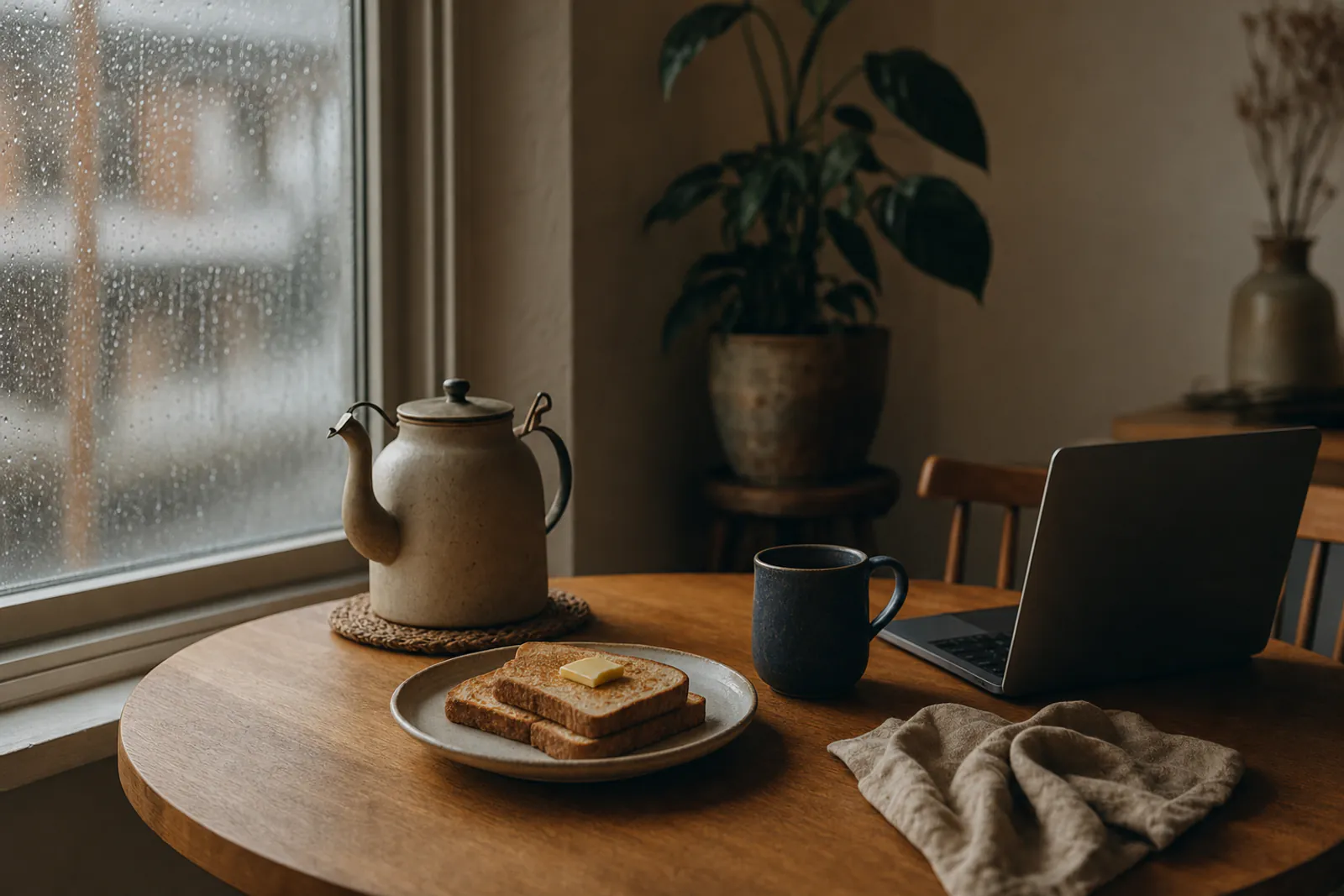
A short lyric becomes singable when the verse is slightly longer than the chorus and every section has a job. Here is a compact kitchen-at-6am example you can copy into a lyrics to song workflow after you choose a style.
[Verse 1]
Kettle clicks at six AM
Toast burns black beside the sink
Your blue cup cools beside my hand
Rain dots the half-lit window

[Pre-Chorus]
I leave the porch light on
But you do not turn the key

[Chorus]
Come back slow, come back slow
Kettle holds a small glow
I left your cup below
Come back slow, come back slow
| Section | Line | Syllables | Note |
|---|---|---|---|
| Verse 1 | Kettle clicks at six AM | 7 | Time and sound arrive fast |
| Verse 1 | Toast burns black beside the sink | 7 | One smell, one place |
| Verse 1 | Your blue cup cools beside my hand | 8 | The absent person appears through an object |
| Verse 1 | Rain dots the half-lit window | 7 | Outside image closes the shot |
| Pre-Chorus | I leave the porch light on | 6 | Tension, not answer |
| Pre-Chorus | But you do not turn the key | 7 | Unfinished thought before chorus |
| Chorus | Come back slow, come back slow | 6 | Title phrase on line 1 |
| Chorus | Kettle holds a small glow | 6 | Simple image, open vowel |
| Chorus | I left your cup below | 6 | Consequence and rhyme |
| Chorus | Come back slow, come back slow | 6 | Title phrase returns exactly |
For verse 2, do not write the kitchen again. Move the camera:
[Verse 2]
Hall light hums above your coat
One shoe leans against the door
My phone face-down beside your note
Steam fades from the kitchen floor
That keeps the same emotional subject, but the scene has changed.
Write the bridge as a new angle, never the title again
The bridge should give the listener a fresh angle instead of repeating the chorus in different clothes. Keep it 2-4 lines, usually 6-10 syllables per line. It can be the other person's view, the morning after, a plain admission, or the detail the verses avoided.
For the kitchen song, the title is Come back slow, so the bridge should not say that phrase. Try a new angle:
[Bridge]
Maybe I locked the wrong side first
Maybe you knocked and I slept through
Both lines sit near 8 syllables, and the speaker takes some blame. That gives the final chorus a different color without changing the words. If you want a bigger lift, place [Key Change] on its own line before the last chorus, but skip it if the song is small and acoustic. A quiet song often needs less drama, not more.
Weak bridge:
[Bridge]
Come back slow, come back slow
I need you more than you know
Single fix: remove the title from the bridge and add one fact the verses did not admit.
Fix rushed, flat, or generic AI lyrics with one edit
Most AI lyric problems get better when you cut the longest line or swap one abstract phrase for a physical object. Do not rewrite the whole song first. Find the single broken part and change that.
| Symptom | Likely cause | Single change | Before | After |
|---|---|---|---|---|
| Vocal rushes line 3 | One line is 3 or 4 syllables longer | Cut filler words | I keep wondering if you will ever come home | I wonder if you will come home |
| Chorus feels flat | Title is hidden or changes each time | Repeat exact title line | Maybe you will return someday | Come back slow, come back slow |
| Verse sounds generic | Abstract emotion with no place | Add location plus object | I feel lost inside | Your blue cup chills beside me |
| Section feels crowded | Too many lines under one tag | Keep verse to 4 lines, sometimes 8 | 12-line verse block | Two 4-line verses |
A useful revision prompt is:
Rewrite this verse at 8 syllables per line, ABCB rhyme, one kitchen scene, no phrases about storms, dreams, wings, or echoes.
Use prompt help for style and revision language, not as a substitute for editing. A page on Suno prompt patterns can help you frame tempo, key, and arrangement while your lyric stays plain and measurable.
If the chorus keeps missing, shorten line 2 first. That usually gives the singer more room to land the title on line 4.
Use this final checklist before you generate
Before you send lyrics to a generator, check title placement, line length, section tags, and concrete images. This takes less effort than fixing a messy vocal after the fact.
- The chorus was written before the verses.
- The title phrase appears on chorus line 1 and line 4, exactly repeated.
- Verse lines sit around 7-9 syllables.
- Chorus lines sit around 5-8 syllables.
- Every line in a section stays within 2 syllables of that section median.
- Verse 1 is one scene with objects you can photograph.
- Verse 2 moves the scene instead of restating verse 1.
- The pre-chorus ends on an unfinished thought.
- The bridge plan is 2-4 lines, 6-10 syllables, with a new angle.
- The bridge does not use the title line.
- Cliches like
neon lights,broken wings, andechoes in the nightare gone. - Tags sit on their own lines.
- No verse tag is empty.
Final paste shape:
Style: 96 BPM, C major, warm synth pop, tight kick, muted guitar, close lead vocal

[Verse 1]
Four lines, one scene, 7-9 syllables each

[Pre-Chorus]
Two lines, 6-9 syllables each

[Chorus]
Title line
Image line
Consequence line
Title line
You can use the same checklist on a scratch draft, an AI-assisted draft, or a text to song paste.
Frequently asked questions
Do my lyrics have to rhyme?
No. Rhyme is optional in verses if the rhythm is strong and the images are clear. For beginners, ABCB is a safe verse scheme because only lines 2 and 4 need to rhyme. Choruses usually want denser rhyme, such as AABB or AAAA, because repeated sound helps the hook feel settled.
How many syllables should each song lyric line have?
Use the section as your guide. Verses usually work at 7-9 syllables per line, pre-choruses at 6-9, choruses at 5-8, hooks at 4-7, and bridges at 6-10. Inside one section, keep each line within 2 syllables of the median so the vocal does not rush.
Should I write the chorus or the verse first?
Write the chorus first. The chorus carries the title, the main promise, and the part people remember. Once that exists, the verses only need to aim at it. A good order is chorus, verse 1 scene, pre-chorus lift, verse 2 movement, then bridge angle if the song needs one.
How long should song lyrics be?
A practical beginner lyric can be short: verse 1, pre-chorus, chorus, verse 2, chorus, bridge, final chorus. A 4-line verse and 4-line chorus are enough if the lines are strong. Avoid huge 12-line sections unless you are writing rap or spoken delivery, because sung AI vocals may compress them.
How do I stop lyrics from sounding generic?
Replace broad feelings with objects, places, and time. I feel lonely is generic. Your blue cup cools beside my hand gives the singer and listener a picture. Cut common phrases such as city of dreams, through the storm, broken wings, and echoes in the night unless you rebuild them with a fresh image.
Can I use AI to write lyrics and still make them mine?
Yes, if you treat the AI draft like raw material and edit it hard. Keep the lines that match your title, then fix syllable counts, add concrete nouns, remove cliches, and make the chorus repeat exactly. Your taste shows up in what you cut, what you keep, and the images you choose.
How do I get an AI singer to follow my lyrics?
Use clean structure tags on their own lines, such as [Verse 1], [Pre-Chorus], and [Chorus]. Put no words before the first tag. Keep each section short, with even syllable counts. If the vocal rushes, find the longest line in that section and cut it until it matches its neighbors.
Keep exploring
 Learn music production with AI, from beats to promptsLearn AI music production through beginner guides on computers, drum programming, sequencers, arrangement, and prompt writing for finished tracks.
 Turn lyrics into a song with AI vocalsPaste lyrics, add verse and chorus tags, choose a style, and generate a sung AI track with clear structure, melody, vocals, and instruments.
 AI lyrics generator for songs people can singWrite AI lyrics that can be sung, with verse, chorus, hook, rhyme and style prompts. Turn an idea into a finished vocal track from one clear concept.
 Suno meta tags for cleaner lyric blocksUse Suno meta tags in lyrics with verse, chorus, build, drop, delivery cues, placement rules, copy-ready skeletons, and sung-tag fixes for cleaner song forms.
 Song structure for beginners: forms, bars, and tagsLearn song structure with bar counts, BPM timing, common forms, energy maps, chord moves, and AI section tags for pop, hip hop, EDM, rock, folk, and ballads.
 Suno prompts with a producer's style formulaWrite tighter Suno prompts with a 13-slot style formula, lyric-field rules, artist-reference translation, and one-change fixes for AI song drafts.
 Text to song AI for written song ideasTurn a written idea into a finished AI song with genre, mood, voice and instruments. Learn how to write prompts that shape verses and choruses.
 Love song generator for real memoriesCreate a personal love song from memories, lyrics, and a style: indie pop, R&B, piano ballad, country, or soul for anniversaries and proposals.
One idea · one finished track
Ready to make your track?
Describe the idea, pick a style, and SoundUser writes, sings and mixes the song.
Start with the generator